Why Can’t We be Sweden? Try Denmark
Inside the Scandinavian model (A guide for Canadians)
We often lump the Scandinavians together over how they manage high subsidies (and high taxes) of a universal high quality care economy.
How Can Scandinavians Tax So Much? Henrik Jacobsen Kleven
The short answer is that universal subsidies for high quality care supports hard work and productivity. However, Sweden and Denmark often take very different approaches to how to spend tax dollars to create high quality public services.
I will give a short explanation of how these countries use different approaches in regulating their childcare systems. I will also give a short explanation to Canadians - who worry about the quality of childcare despite the positive experiments on worker productivity in Quebec - why they may see a more plausible and viable regulatory model in Denmark, than in Sweden.
The danger of ignoring coordinated childcare admission systems
It is often noted by Scandinavians that Sweden and Denmark approach the welfare state differently. Various articles, such as Dahlberg, Moss, and Pence (2007), highlight the two approaches:
Sweden exemplifies a model in which quality assurance is achieved through national curricula, uniform regulations, and centralized inspection systems.
In contrast, Denmark’s system emphasizes local autonomy, granting municipalities and individual providers significant freedom to tailor services to local needs and parental preferences
However, an important missing piece of this story in childcare is childcare admissions. Even in suveys dedicated to childcare, I find very few discussions of the important differences between the visible admission systems that operate in each country. Asking how the admission systems function in each country gives us ideas about our options for creating centralized admissions systems in childcare — and the specific narrow and broader goals they serve.
Here is an analogy to explain the danger of ignoring admission systems. We know from biology that a rock pocket mouse’s coat matches its environment — but the color is a trait of the mouse, not the surroundings.

In this post, I want to distinguish between the features of daycare admission systems design (chosen by municipalities), and how policies are decentralized (chosen by national policy). Like the rock pocket mouse’s color and the color of their environment, these policy characteristics may appear to be closely related, but they are not the same.
The distinction is important, because it helps us focus on the crucial interplay between
the important, but sometimes invisible regulation of central admission systems, which are chosen at the regional level, and
the overall regulations on daycare quality, which are negotiated nationally.
Exploring these differences offers valuable insight for anyone navigating Denmark’s world-leading approach to daycare. Our goal is to guide observers toward the key aspects of systems like Copenhagen’s while also highlighting contrasts with other models — such as Sweden’s — where rules governing central admissions are likewise clearly defined and openly accessible.
Designing admissions systems for “variety” or “conformity”
One type of regulation that gives, or limits, the diversity of daycare approaches for childcare is through daycare access. The admission system impacts diversity, because it controls what daycares are available to parents.
SWEDEN: For example, the local catchment priorities of the city of Uppsala in Sweden works to limit the diversity of daycare, because parents are always presented a similar choice - stay at home or go to the nearest daycare.
DENMARK: By contrast, a city like Copenhagen embraces the widest possible choice, because any two parents in the city with children of the same age are on equal footing to choose any daycare in the city. Copenhagen goes another step further. Copenhagen has two spaces for admissions that greatly impact the variety of daycare services. One space is the centralized admissions portal, where approved daycares are listed and accessed through a transparent, standardized process. The other space consists of private admission systems for alternative, often more informal, services that parents might temporarily use before receiving an offer through the central system.
How we usually think about quality regulations: A very different type of regulation that gives, or limits, the diversity of daycare approaches for childcare is by quality regulations on possible standards of care. In practice, quality regulation creates a list of guidelines that daycares must follow. If this list of guidelines is extremely strict, daycares options to create different are limited. Here, we can note that Sweden typically operates much stricter regulations about the range of daycare qualities than is permitted in Denmark.
The ‘‘daycare quality regulation paradox”
Is there an increased role for rules and regulations after we set in place more extensive subsidies for daycare? I think the answer is yes, but perhaps not in the way that many policy discussions and comparative studies of daycare systems (which often ignore daycare admissions systems) lead us to debate. In my alternative framing of this answer, the regulation of quality standards - as they are typically understood for consumers - more accurately mirrors:
the impact of the subsidies on expenditures on childcare
the impact that subsidies have on the choices of admission systems in different locations.
Hence the crucial importance of understanding admission systems, which is ignored in many national policy discussions. In making this argument, which we might call the ‘‘daycare quality regulation paradox”, we can unpack discussions of the role of subsidies for discretionary services that are chosen by consumers (which are uncommon in many places such as the United States) and quality regulations (which are heavily used in most rich countries, including the United States). The distinct evolutionary paths of daycare systems in Sweden and Denmark is a useful example.
Let’s begin with a key assumption: In Scandinavia, generous public subsidies for daycare are expected to raise demand by users for higher standards. The argument works like this. Providers that promote higher standards must deliver them through observable investments — more qualified staff, lower child-to-caregiver ratios, and better facilities. Borrowing from air travel, public daycare funding in Scandinavia sits comfortably between “economy plus” and “business class.” With higher subsidies and competition, daycares deliver professional staff and meet rigorous ratios, like five children per caregiver. Detailed regulations that place strict standards are not necessary. High standards emerge not because they're imposed, but because the funding model and natural service competition (given any effective system of comparing outcomes) enables and incentivizes them.
This assumption is meant to make a somewhat subtle, but important point. The regulations for daycare quality can either be
regulations that encourage diverse choices, but make them safer for consumers.
regulations that remove the need for choice altogether by restricting that all providers meet the same standard.
The first type of quality regulation is neutral - a mirror if you will - in the face of higher subsidies, because the higher standards of service are already regulated, and questions of access is regulated by admissions and fee policies. However, the second type of quality regulation - quality restrictions - is a policy lever for policy markers, if it is not treated as a mirror of other parts of the overall regulatory system. For example, walk zone admission priorities used in Uppsala, Sweden more naturally limit daycare diversity, while age admission priorities used in Copenhagen, Denmark more naturally foster greater diversity. So quality regulators, advocating stricter quality standards as they do in Sweden, can thereby choose to override natural local forces that affect quality diversity through admission systems, which might aim to give users greater choice and agency.
Virtuous policy cycles
In Copenhagen, the daycare admissions system is a central policy lever. It determines who attends which centers, how diversity is distributed, and which care models survive or decline. Given its influence, it is worth asking: why would national governments delegate control over such a powerful tool? And what risks arise from dividing responsibilities between local and national authorities?
The daycare quality regulation paradox helps explain both the rationale for delegation and the tension that can emerge when national policy unintentionally (or otherwise) undermines local tools. Delegation reflects a practical truth: effective decisions often depend on local context. For example, a city with many potential home-care providers, with homes featuring safe, spacious yards may be especially well suited to support small-scale, home-based daycare models like Copenhagen’s dagpleje. Admissions systems play a key role here — not only in allocating spaces in public centers, but in shaping the ecosystem in which alternative forms of care can grow and thrive.
National governments typically retain the authority to enforce daycare quality through stricter regulations of what providers can do, and through general provisions for certain groups. I think that Swedish national policies are in line with the visible centralized admission systems that local governments use in Sweden. The paradox for policy emerges when national policymakers, in trying to improve quality system-wide, rely on rigid standards that inadvertently constrain local innovations — especially innovations to decentralized admissions systems and consumer choice. Local centralized admissions policies - like Copenhagen - can serve not only to distribute children, but to promote quality by shaping competition, supporting specific care models, or encouraging diversity. When national standards ignore or override these local instruments, they may limit the effectiveness of more refined, context-sensitive approaches to achieving shared goals.
Why Can’t We Be Sweden?
Some years ago, a student in my early childhood education and care (ECEC) policy course at Ryerson University (CANADA) asked an emblematic question: ``How can we become Sweden?'' Sorry to say for many of us who have long advocated for universal, high quality childcare — the short answer is ``we can’t.'' Martha Friendly, Director CCCPA
Like Martha Friendly, I’m struck by the frankness of her student’s question. I also agree that many of the objectives Martha advocates for in early childhood education and care (ECEC) systems are indeed met in both Sweden and Denmark. However, I believe it's important to recognize that these two countries achieve their goals through different approaches — differences that offer valuable lessons for daycare systems that are given broad national mandates to create a universal tax-funded model. From the vantage point of access and its administration at the local level, we can begin to consider an additional set of answers to Martha Friendly’s student — answers that I hope will prompt any student with similar questions to examine admission systems more closely. These answers concern the balance between local and national governance, and the local processes that offer steps to help decentralized daycare systems evolve so that these systems effectively use universal subsidies to provide high quality daycare solutions for the majority of parents and children.
The reason it is difficult to transform daycare systems, which are grounded in market driven care, to a system resembling Sweden’s tax funded care is that Sweden does two fundamental things differently from what is done in Germany and its capital city of Berlin, or any other decentralized system that is implementing national daycare subsidies. First, Sweden imposes strict centralized quality controls on all daycare providers. This removes much of the agency parents typically have in more decentralized systems to choose among a wide variety of care models or to directly influence quality through market feedback. This system of strict regulations depends on two critical assumptions: that strict regulations can be effectively enforced, and that parents broadly accept the values and goals behind those regulations. This is a significant cultural and institutional shift, as it overrides the more established dynamic where varied providers respond directly to parental demand.
Second, Sweden also relies on a coordinated, centralized admissions system — similar to Copenhagen — where parents apply through municipal platforms with common priorities rather than directly to providers. This is a signifigant shift in how daycare providers are expected to manage daycare admissions.
Together, these two features — strict regulation and coordinated admissions — form the backbone of the Swedish model. Adopting both would require a major transformation not just in governance and administrative systems, but in public expectations and trust.
Why Canadians might look to Denmark?
But if we can't be Sweden, what are our options. One place to look is at countries that share similar views towards agency of parents to make decisions about daycare as in Canada or Australia.
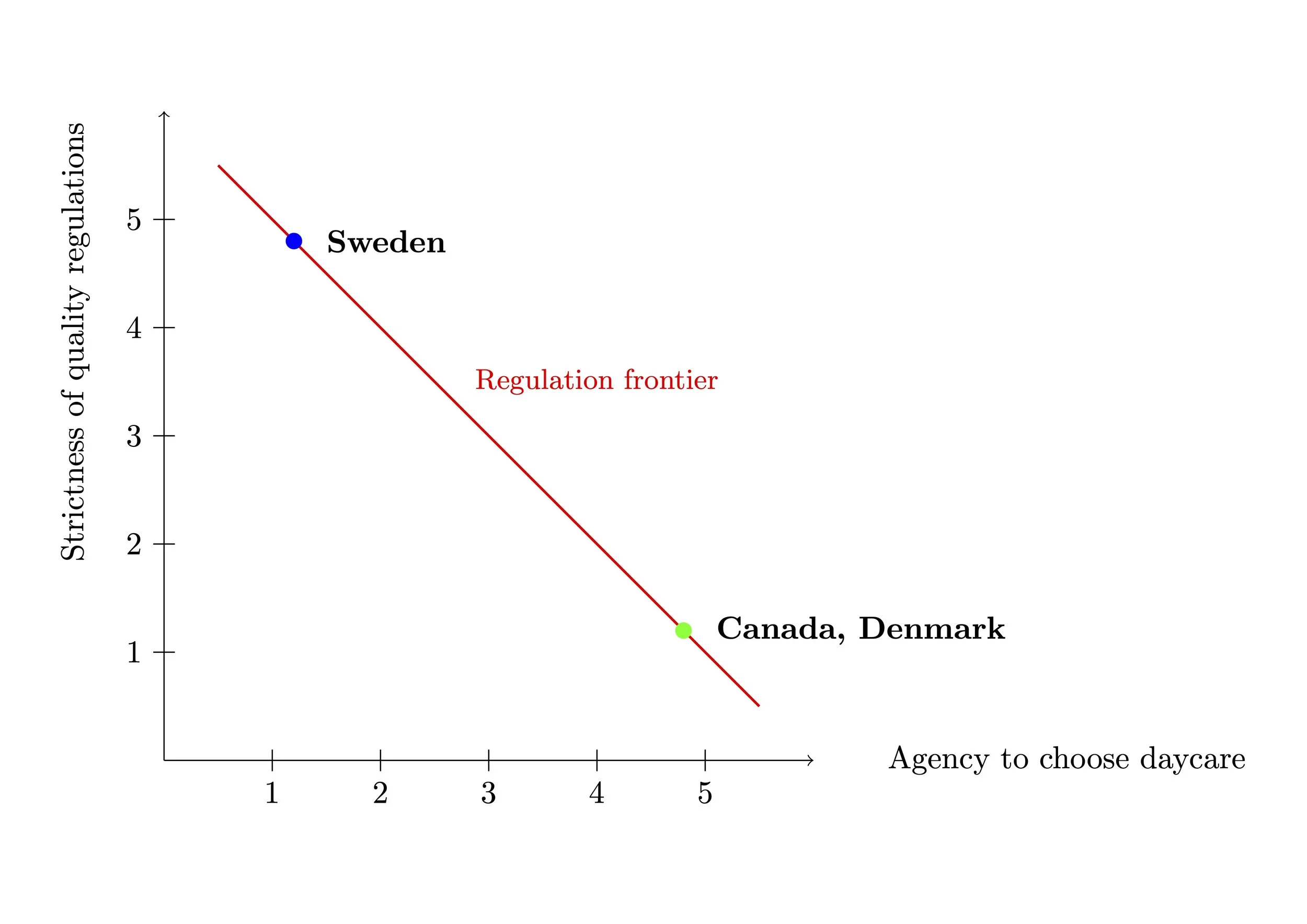
Regulatory frontier for Sweden and Denmark (And Canda)
The daycare system of Denmark and the methods that Copenhagen uses to implement this system offers a different approach than Sweden. The regulation frontier, which is depicted in my simple description of the regulatory frontierabove, helps explain why Copenhagen might be a good model to consider. Unlike in Sweden, the Danish government does not impose strict guidelines on the delivery of care, and chooses instead to leave the methods of delivering high quality care to local authorities. Therefore, the Danish system works from an initial position, which resembles more closely decentralized daycare systems like that of Canada.
Why market design in childcare?
How can we use childcare admission design to move childcare systems in cities like Berlin and Toronto closer to Copenhagen?
The Danish approach to daycare is different than in Canada (or Germany), because centralized admissions offers coordinated rules and visible outcomes of the inputs and outputs of the admissions process. This admission system creates similar agency, as decentralized systems, for parents and providers to adapt to each other circumstances. However, this admission system also helps Copenhagen closely monitor this adaptive process and to create solutions to solve service gaps and identify improvements. From a process-oriented perspective, the Copenhagen system offers a path that emphasizes the strengths of centrally coordinated admissions while also preserving the agency of both parents and providers. Unlike the Swedish model, the Danish approach does not rely heavily on trust that all daycare providers consistently deliver high-quality services. Instead, quality is supported through a system of regulated subsidies and fees, giving agency to parents to choose when and where to go to daycare, giving agency to daycare managers and staff to adapt new formulas for care subject to different capital costs, and developing the cities overall capacity to closely monitor outcomes through well-developed local administrative systems.